PI
Core/Dual
Tim Kraska
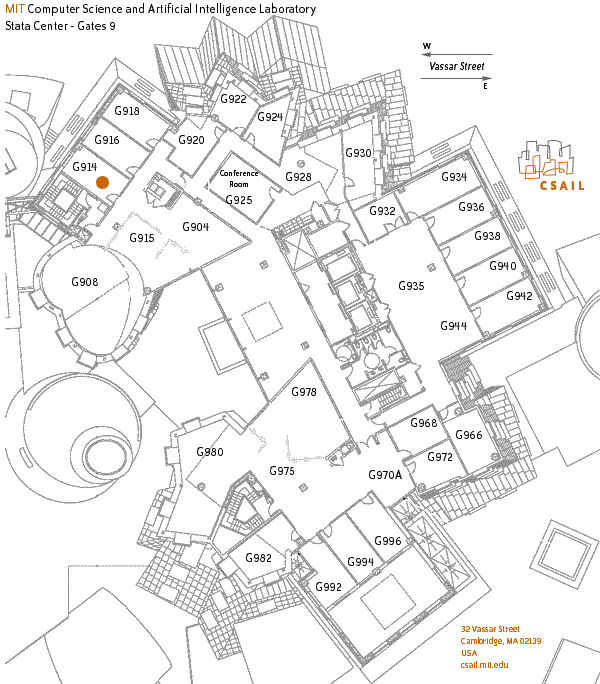
Room
32-G914I am an Associate Professor of Electrical Engineering and Computer Science at MIT, where I am part of the Data Systems Group in CSAIL, and a Director of Applied Science at Amazon Web Services (AWS). I co-direct MIT’s Generative AI Impact Consortium (MGAIC), the Data Systems and AI Lab (DSAIL@CSAIL), and the new Everest@CSAIL initiative. I also co-founded Instancio and Einblick Analytics, both of which were acquired.
Before joining MIT, I was an Assistant Professor at Brown University, and spent time at Google Brain. I am a Sloan Research Fellow and have received several awards, including the VLDB Early Career Research Contribution Award, the Intel Outstanding Researcher Award, the VMware Systems Research Award, Brown University’s Early Career Research Achievement Award, an NSF CAREER Award, and multiple best paper and demo awards at VLDB, SIGMOD, and ICDE.
My current research focuses on agentic systems and the use of large language models (LLMs) and artificial intelligence (AI) for data-centric problems and systems building.
At MIT, my work centers on how AI will transform the design and development of large, complex software systems. The guiding question is: How should we build software in a world where most code is written—or co-written—by AI? This includes rethinking development practices and exploring how to modernize and evolve existing, data-centric software stacks. In contrast, with Palimpzest, we are developing declarative frameworks for optimizing AI workloads, particularly for data-intensive applications. With KramaBench, we introduced the first benchmark for data-science agents and are now investigating new techniques for building deep research and data-science agents — from long-context optimization to graph-based reasoning and beyond.
At Amazon Web Services (AWS), I lead the science teams behind Q SQL** and Bedrock Structured Knowledge Bases, several core components of AgentCore, graph-based knowledge-base construction for data-science agents, and several first-party agents, which will be released in the coming months.
In parallel, I continue to advance our long-standing research on Machine Learning for Systems. For example, with BRAD we explore how we can virtualize and automatically optimize data infrastructure; applying many of the insights from our previous work on learned scheduling, query optimization, and resource management.
Related Links
Last updated Nov 24 '25