To innovate as a technologist, you need to be a polyglot—fluent in multiple languages of problem-solving, able to synthesize ideas across domains, reframing puzzles to visualize different outcomes, and revealing the questions that have yet to be asked.
For Rebecca Lin — a graduate research assistant at the MIT CSAIL, the Future Sketches group at the MIT Media Lab, and a 2025 Design Fellow at the MIT Morningside Academy for Design (MAD) — one of those languages is art.
“I develop mathematical abstractions and computational tools that facilitate new approaches to art, design, and fabrication,” she explains. “By transforming abstract concepts into visual and material systems—mathematical graphs into geometric patterns, which can then be articulated through code and craft—it’s possible to expand our vocabularies for reasoning and making.”
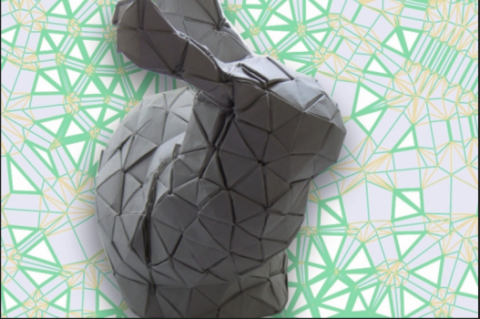
As part of a research collaboration with Craig S. Kaplan, professor in the School of Computer Science at the University of Waterloo, Lin has developed an open source encoding-decoding framework that represents Islamic ornamental geometric patterns in the form of triangulated graphs. These graphs can then be automatically re-translated into constellation patterns calibrated to varying degrees of complexity.
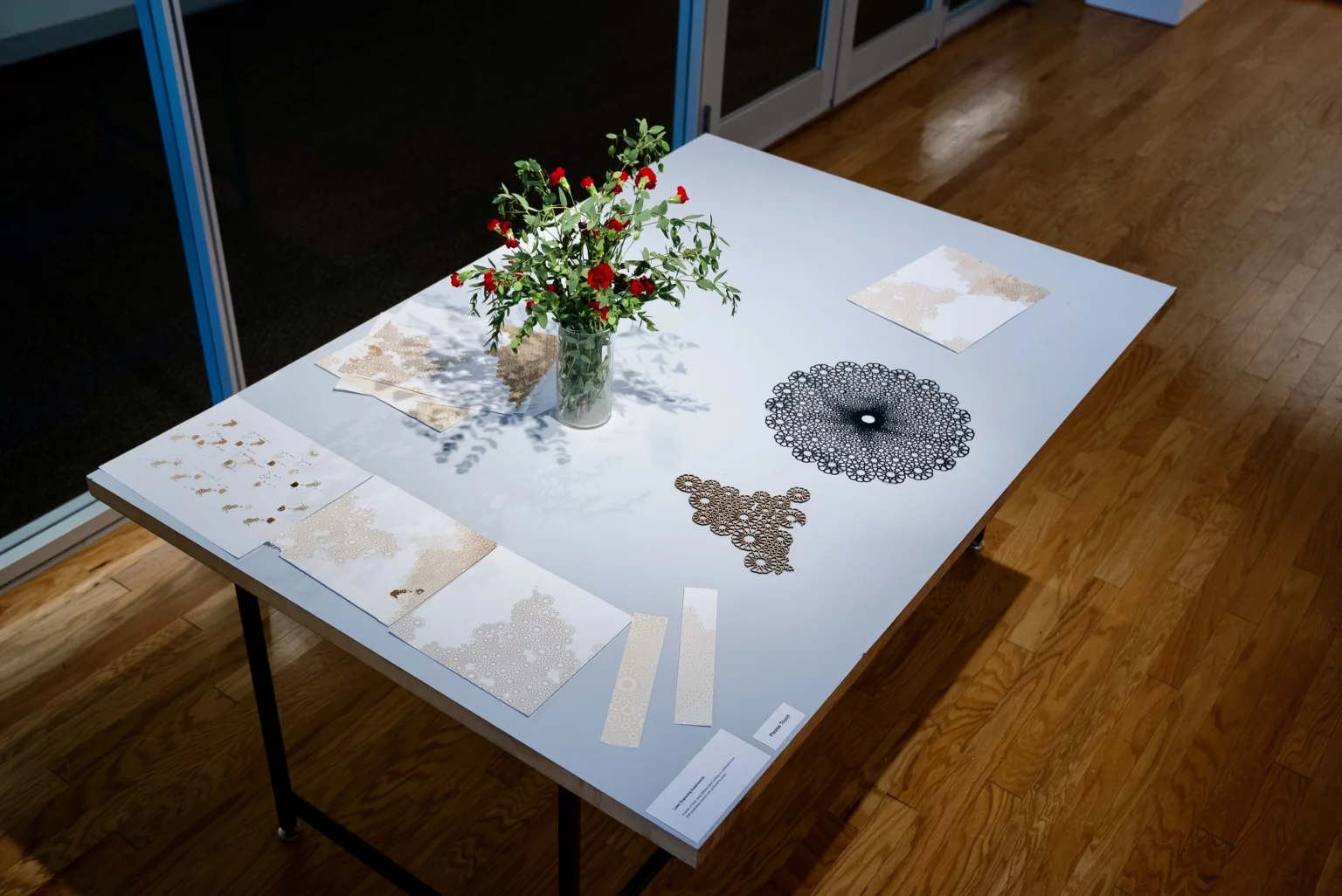
Lin has used the patterns generated by her research to create physical works of art, experimenting with media including collage, laser engraving, layered plywood reliefs, fabric sculptures, 3D-printed studies, and animated light pieces. These artworks are presented in the exhibition Encoding-Decoding Constellations at the MIT Wiesner Student Art Gallery, and Lin’s guiding premise can serve as a key for innovators of all kinds: “our choice of representation shapes what we can create.”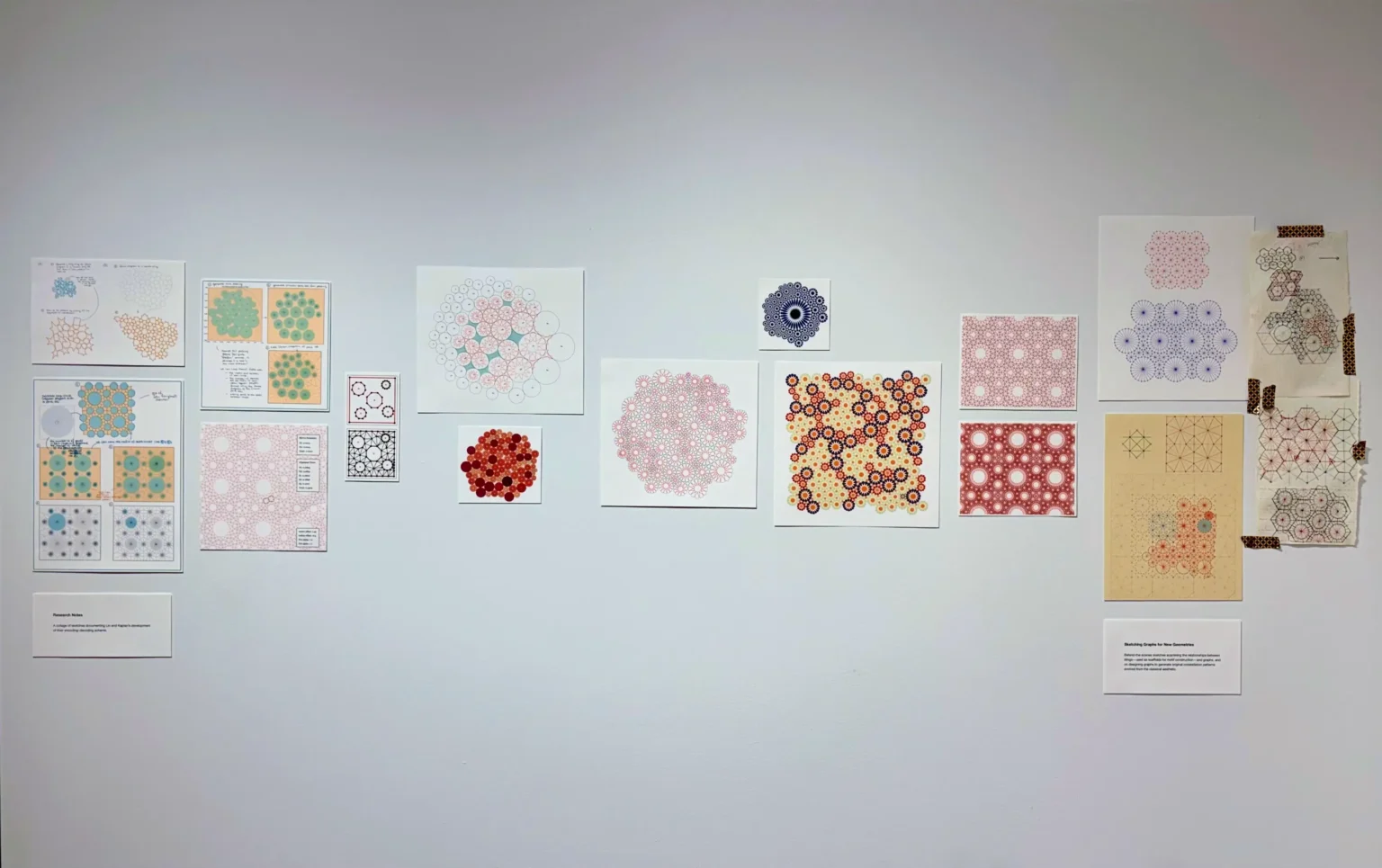 Sensory geometry
“I love sensory experiences and handcraft,” Lin reflects. “Each artwork foregrounds different aspects of the geometry—precision, texture, flexibility, translucency—and reveals how digitally generated forms interact with various materials and physical constraints. I wanted to discover how patterns drape when cut from flexible fabric, how light and lasers trace motifs across acrylic and paper, how plywood carvings create layered shadows, how structure and chaos interact when etched into wood versus printed into 3D sculpture.”
In the exhibition, projected animations use computational tracings of circle packings and graphs to reveal hidden structures and dynamics. A series of textile studies interpret geometry as a wearable form, suggesting possibilities for fantastical garments. Laser-cutting experiments involved weeks of trial and error, testing the variations in markmaking that could be achieved with different lasers in labs across campus. While Lin led the design and concept for each work, fabrication was achieved in collaboration with two master’s students in the MIT Media Lab’s Program in Media Arts & Sciences: Ben Weiss, who handled the process of 3D printing, and Yufeng Zhao, who developed the projection mapping for the light animations.
Working with Erik D. Demaine at CSAIL and Zach Lieberman at the MIT Media Lab has allowed Lin to recognize the correlation between her research and her art practice. Discoveries in theoretical problem-solving inspire experiments with craft techniques; the resulting artworks lead to more insights for new mathematical and computational frameworks. “The synergies between computation and craft come to light as I’m translating between media,” says Lin. “I find that the dialogue between art and research opens up a richer space—a search space—where new concepts and forms can be realized.” Translation as method and mindset
For Lin, translation is not only a research framework—it’s part of her life experience. Growing up bilingual in English and Mandarin, she became attuned to the ways that language shapes perception. “I reach for different languages depending on how I’m seeing or feeling,” she says. “That sensitivity to switching modes is mirrored in how I work, moving between math, computation, handcraft, and design.”
The visual qualities of Chinese characters also shaped her approach to form. “Each character feels like a tiny drawing, components that combine into meaning,” she says. “That logic of assembly echoes the way I think about geometric patterns and modular design.”
From math, to code, to text, to texture—Lin is determined to investigate and express what she calls “permissionless change,” a practice of moving freely and intentionally across research areas, media, and identities that resonate with her. It’s a theme that carries into her design research as a 2025 Design Fellow at the MIT Morningside Academy for Design.
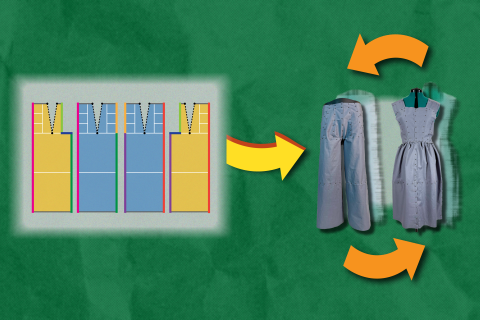
Her project Refashion explores clothing as a modular, reconfigurable system. Users assemble garments from fabric modules connected by reversible interfaces; companion software generates new designs, simulates fit, and optimizes module usage. “Adjusting a garment to fit a body, or a change in style, is fundamentally a geometrical problem,” says Lin. “By imagining clothing as dynamic assemblies rather than static products, we give people the agency to resize, restyle, and remix what they wear. Humans evolve—our garments should be able to evolve with us.”
Ultimately, Lin’s art and research are grounded in a deep attention to beauty—not as surface decoration, but as a way of understanding the world. “I see the beauty of geometry everywhere,” she says. “In infrastructure, in the venation of leaves, in the texture of the Charles River on a windy day, in the formations that appear on a beach at low tide.”
By reframing mathematics and computation as artistic media, she aims to show how abstract structures can shape, and be shaped by, human experience. “Witnessing beauty is my way of feeling alive and open to the world,” says Lin. “Through my work, I want to translate that beauty in ways that resonate with others—exploring how mathematical frameworks, craft, and computational tools can illuminate our personal and shared experience.”